

Most US brands set their first Asian price the same way. They take the US retail price, convert it, add freight and check that the margin still works. It feels disciplined, because it starts from a number the business already trusts.
The question is not simply whether the margin works on paper. It is what the price is made of once the product reaches the customer. In Asia, that depends on three layers the US price never had to carry: border costs, consumption tax and the channel. Each changes sharply from one market to the next.
The misleading assumption is that price is a calculation that starts at home. In practice, it is a structure that is built locally and then judged against local alternatives. The same serum can be overpriced in one market and underpriced in the next.
The border layer alone varies widely. For a US cosmetic product, four markets look like this:
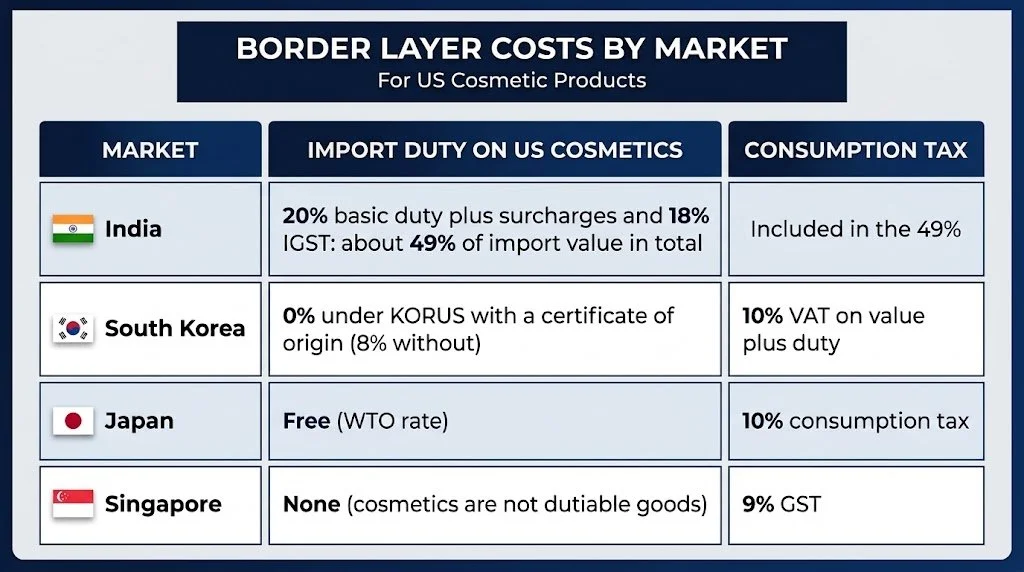
Sources: EximPe (India, HS 3304.99), Treayo Korea, Treayo Japan, Japan Customs, Trade.gov, IRAS, Aspire.
Duty rates should be confirmed against each customs authority at the time of shipment.
This matters because the border layer is visible and gets budgeted. The channel layer often does not, and it is usually larger. Korea's Fair Trade Commission found that cosmetics carried the highest average commission of any category it surveyed in 2024. Olive Young's in-store commission was 40%, rising to about 55% once promotion, incentive and information fees were added. Coupang's cosmetics commission was 25.8% (a prior-year figure) (Daum, iNews24). In Singapore, Shopee's Health & Beauty commission for non-Mall sellers is 11.99%, plus a 3.27% transaction fee (OneCart).
The implication for expansion is that "Korea" is not one price decision. A brand selling through Olive Young and one selling through Coupang face channel costs more than ten percentage points apart. A brand that prices once for the market will be wrong in at least one channel.
The obvious consequences of getting price wrong are thinner margins and slower sales. The less obvious ones last longer.
The margin is decided before launch. A price built from the US number can leave the brand with very different net revenue per unit by market. Where the channel takes 40% or more, the brand has little room to fund marketing, returns or a distributor.
The launch price is sticky. A price that is too high pushes the brand into discounting. Research shows frequent deep discounts lower the price customers consider normal for a product (Sheinin & Della Bitta, 2021, global). On promotion-led platforms, a brand can train its customers to wait for the next sale.
The market gets the wrong verdict. When a mispriced product sells slowly, leadership may conclude the market lacks demand. A company may therefore exit a market that was never really tested.
Channels start to pull against each other. A high-commission retailer and a low-commission marketplace pull toward different shelf prices. The brand then has to choose between margin and price consistency.
The risk emerges when the price is fixed before the cost stack is known. By the time it becomes clear, launch inventory is labelled, listings are live and the price is public.
What executives should consider is building price from the customer backwards, not from the US price forwards. That means starting from the shelf price of credible local alternatives, then subtracting tax, channel fees, distribution and logistics. What remains is what the market can pay the brand. If that is below the brand's floor, the problem is visible before launch rather than after.
That changes three decisions:
Market sequencing. A market whose cost stack leaves a healthy margin can go first. One where border and channel costs absorb most of the price may need a different product, pack size or channel before it is ready.
Channel choice. The channel decision is also a pricing decision. Entering Korea through Olive Young or through Coupang implies different margin structures, and should be modelled separately.
Trade compliance. The difference between 0% and 8% Korean duty depends on a certificate of origin. Small administrative steps change the cost stack and should be secured before the first shipment.
Before setting a launch price, executives should be able to answer:
What is the full cost stack, from duty to channel fee, in each target market and channel?
What do credible local alternatives sell for?
What net revenue per unit does each market leave us?
How much discounting can that margin absorb without resetting the price?
Have we secured every tariff preference we qualify for?
The principle is simple, ensure capital preservation through commercial execution: a price that is built correctly protects the margin that funds the next market.
If you are preparing your first Asian launch, Samana works with Entry Brands to build market-by-market cost stacks and set a launch price that holds. To schedule a 15-minute chat to understand more about how we can bolster your Asian trade expansion contact insight@samanaadvisory.com.
Sources, all accessed 29 October 2026.
EximPe – India import duty, HS 33049990 (data as of 13 May 2026)
Japan Customs – Outline of tariff and duty rates (consumption tax 10%)
Trade.gov – South Korea import tariffs (10% VAT; published 29 Jun 2026)
Daum – Korea FTC distribution commission survey (10 Jan 2026)
iNews24 – Korea FTC distribution commission survey (10 Jan 2026)
Sheinin & Della Bitta (2021), Journal of Marketing Theory and Practice
