

For most US brands, the first Asian market is won on a marketplace. Shopee, Lazada, Amazon or Coupang offer traffic, payments, logistics and trust from day one. Sales grow, reviews accumulate, rank improves. By the time the brand is planning its second and third markets, the marketplace model looks proven.
The question is not simply whether the marketplace delivers sales. It is what the brand owns once the sale is made. On most Asian marketplaces, the answer is less than leadership assumes.
The misleading assumption is that a customer who buys on a marketplace is the brand’s customer. In practice, the platform’s rules keep the relationship with the platform. The brand sees orders and aggregate reports. The platform keeps the contact, the repeat traffic and the ability to market to that buyer.
The rules are explicit:
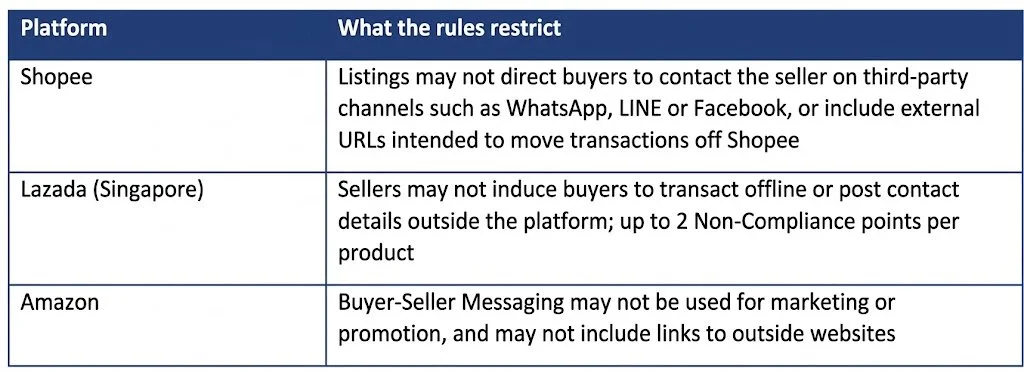
What the brand gets back is usually aggregate. Amazon’s Repeat Purchase Behavior report, for example, shows how many repeat customers a brand has and how much they spend, not who they are ( Intentwise ).
This matters because repeat customers are where the economics of a brand improve. Bain’s Fred Reichheld found that, in financial services, a 5% increase in customer retention produced more than a 25% increase in profit (Bain). The exact figure will differ for skincare, but the principle holds. On a marketplace, the brand pays commission and advertising to reach its repeat customers again, on every order.
The implication for expansion is that marketplace growth can be rented growth. The revenue is real, but the asset behind it belongs to someone else.
Consider a US skincare brand that has sold in Singapore through Shopee and Lazada for three years. Those two platforms accounted for 53% and 35% of Singapore marketplace GMV respectively in 2022, the latest verified figures (Cube Asia). The brand's sales are healthy. But it has no customer list, no direct channel and limited insight into who its best customers are. It is now about to repeat exactly the same model in Japan, Korea and India.
The obvious consequence is margin: commission and ad spend on every repeat sale. The less obvious consequences are strategic.
1. Concentration risk. When most sales run through one or two platforms, a fee increase, policy change or account penalty hits the whole market at once. The brand has no alternative route to the same customers.
2. Thin customer insight. Without customer-level data, it is harder to see which customers are most valuable, why they come back or what they would buy next. Product and market decisions are made with less information.
3. A weaker equity story. When a brand seeks capital or a partner, revenue it can reach directly is a stronger asset than revenue that depends on another company’s rules.
4. Compounding with each market. Every new market launched on the same model adds more platform-dependent revenue, and the problem grows with the brand.
The risk emerges when channel choices are made market by market for speed, without asking what each choice builds. The expansion stage is when that question matters most, because the channel mix set now tends to stay.
What executives should consider is not “marketplace or direct”, but what role each channel plays. Marketplaces are excellent for acquisition, visibility and trust. A direct channel, a loyalty programme or a CRM-led retail partner can be where the relationship deepens. The decision is about sequencing and balance, not rejecting platforms that work.
That changes three decisions:
• Channel mix by market. Decide upfront which channels acquire customers and which retain
them, rather than defaulting to the model of the first market.
• Capital allocation. Treat investment in owned channels and customer data as building an asset,
not as a cost that competes with marketplace ad spend.
• Compliance by design. Build owned relationships through permitted routes, such as brand
websites, packaging and loyalty programmes, rather than through tactics that breach platform
rules and risk penalties.
Before launching the next market, executives should be able to answer:
• ☐ What share of our revenue in each market depends on a single platform?
• ☐ How many of our customers can we contact directly today?
• ☐ What customer data do we actually receive from each platform?
• ☐ Which channel in each new market is designed to retain customers, not just acquire them?
• ☐ What would happen to the market if our main platform changed its fees or rules?
If your first Asian market runs through marketplaces and you are planning the next, Samana works with Expansion Brands to design channel strategies that grow sales and ownership together. Reach out to us at
Sources, all accessed 4 November 2026.
• Shopee – Listing violations guide (Malaysia seller guide, undated)
• Lazada Singapore – Fair Trading Policy
• Seller Labs – Amazon buyer-seller messaging rules (5 May 2026)
• Intentwise – Amazon Repeat Purchase Behavior report
• Bain & Company – Prescription for cutting costs (Reichheld, Loyalty Rules!, 2001)
• Cube Asia – Singapore e-commerce market 2025 (Shopee/Lazada GMV share, 2022 data)
