
The Hero SKU Fallacy: What Southeast Asia’s Protein Bestseller Lists Reveal About Exporting Your Home-Market Winner

Every international expansion plan reaches the same deceptively simple question: which of our products should go? The default answer is the bestseller. It has the sales history, the reviews, and the internal confidence. It is also the answer most likely to be wrong in its specifics
- Brand presence is not SKU presence. A hero brand can appear in a new market’s bestseller lists while its exact home-market SKU does not. Portfolio decisions must be made at the level of size, format and flavour, not brand reputation.
- Test the variables the evidence can actually support. Pack size showed the most measurable divergence in this snapshot, while flavour and format could not be established in Southeast Asia. Treat what is measurable as a decision input and what is unconfirmed as a hypothesis to validate locally.
- A shortlist is an investment decision, not a caution. Selecting three to five Lead SKUs and deferring the rest concentrates launch budget, stock and distributor attention where market acceptance is already demonstrated.
Choosing the right market and the right category answers where to compete and what to compete in. It does not answer what to put on the shelf. Portfolio Selection is the point at which international strategy becomes specific enough to carry commercial risk: one size, format and flavour will move through a distributor’s channel faster than another, and the range chosen determines where launch resources are concentrated.
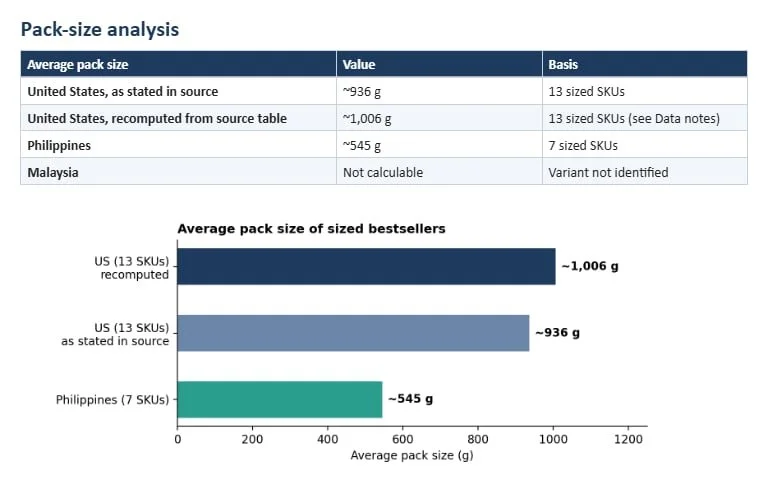
This matters because the home-market range is a record of home-market consumers, their taste, their retail environment and their price sensitivity. None of these can be assumed to transfer. The research snapshot illustrates the point. Even where the hero brand is visible in Philippine and Malaysian bestseller lists, the exact US hero SKU cannot be confirmed, and the pack sizes leading the Philippine list differ materially from those leading the US list. Executives therefore need a market-specific, evidence-led basis for deciding which products deserve investment, and a comparative one, because every SKU admitted competes with the others for the same finite resources.
The most consequential mistake is treating brand-level presence as proof of SKU-level fit. The reasoning runs: our brand sells well in this market; therefore our hero product will too. The research shows why this inference is unsafe. Gold Standard appears at rank 6 in the Philippines and at ranks 1 and 3 in Malaysia, yet neither listing confirms the US hero’s Vanilla Ice Cream flavour, and the Malaysian listing blends 2 lb and 5 lb variants. A second layer of the same error is the belief in a single hero flavour. Even in the US, vanilla-family, chocolate-family and unflavoured products each account for 22% of flavour-labelled bestsellers.
The deeper problem is that the mistake feels like evidence. A strong brand name in a ranking invites the conclusion that the portfolio decision has already been validated, when only the brand decision has.
Product selection decides how a launch performs in practice. Pricing is the first consequence: pack size sets the price a first-time buyer must commit to, and a SKU can be priced out of reach once the full value chain is applied, which is why Framework 08 is run for the specific SKU before it is confirmed. In the Philippine snapshot, the Gold Standard listing at ₱2,899 sits among bestsellers priced between ₱299 and ₱1,284.
Distribution and inventory follow. A broad, home-market-led range can create dead stock in sizes and formats the market does not prefer, tying up working capital and forcing distributor markdowns. Format-specific infrastructure matters too: the framework notes that a format such as RTD requires cold chain capability the distributor may not have. Regulatory and labelling preparation attaches to each SKU, so every additional product adds work before the first shipment.
Sales focus and launch sequencing are affected as well. A SKU that moves slowly in the first six months can put the distributor relationship at risk, and novel flavours or formats require sampling or education budget and should not be expected to deliver Lead-level velocity in the first 90 days. Each of these is a consequence of which SKUs were selected, not of which market was chosen.
Disciplined Portfolio Selection moves in a clear progression: portfolio universe, market evidence, product comparison, portfolio selection, launch priorities, resource allocation.
It begins by listing every exportable SKU, then builds the market picture independently of the brand, mapping what leading players sell across sizing, flavours and format from bestseller lists, distributor sell-through and local-language content, sorted by sales rather than rating. Each SKU is then compared against that map and given a status of Lead, Include, Differentiation or Hold, with at least two Lead or Include ratings required for entry. Gaps competitors have left open are identified, and one barrier is flagged per SKU.
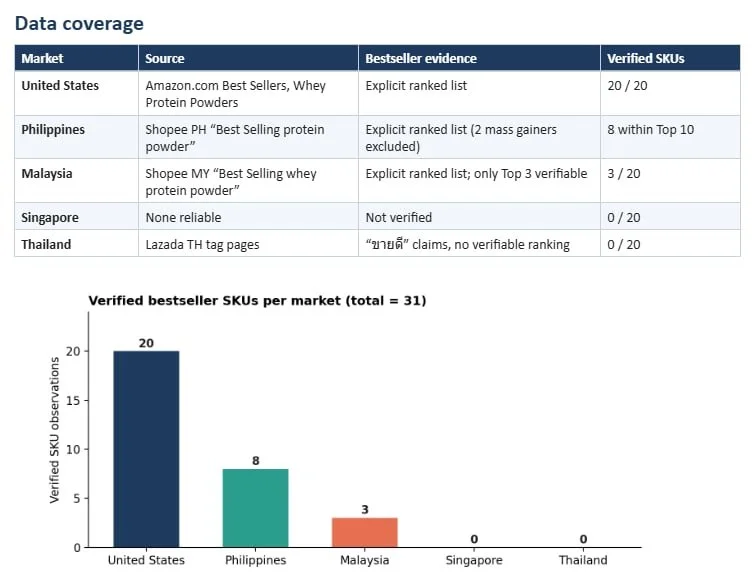
The output creates clarity on five questions: what launches first, what follows, what is tested, what is deferred, and what is excluded. It also states its own evidence limits, as the research snapshot does, and treats unconfirmed variables as items to validate rather than as findings
Illustrative scenario. The brand and its range are hypothetical; the market signals are drawn from the October 2026 research snapshot. The ratings are a demonstration of the logic, not a finding.
Brand A sells whey protein in the United States. Its hero is a 2 lb vanilla tub. Its range also includes a 1 lb chocolate tub and a 5 lb unflavoured tub. It is considering the Philippines, where market and category choices are already made. Step 1 shows the Philippine bestseller list concentrated around 454 g packs, with 2 lb products present at ranks 6 and 7, no verified 5 lb listing, and chocolate the only stated flavour among verified SKUs, though on a single observation. Format is not specified in any verified listing.
Laid against this map, the 1 lb chocolate tub is the strongest candidate for Lead on size, with flavour and format to be validated with a distributor. The 2 lb vanilla hero is an Include at best on size, since 2 lb is present but not dominant, and its flavour is unconfirmed. Its barrier is size and pricing mismatch, so Framework 08 is run before it is confirmed. The 5 lb tub is a Hold: no verified Philippine bestseller matches it. The home-market hero moves from leading the portfolio to supporting it, and launch investment concentrates behind the SKU the evidence most favours.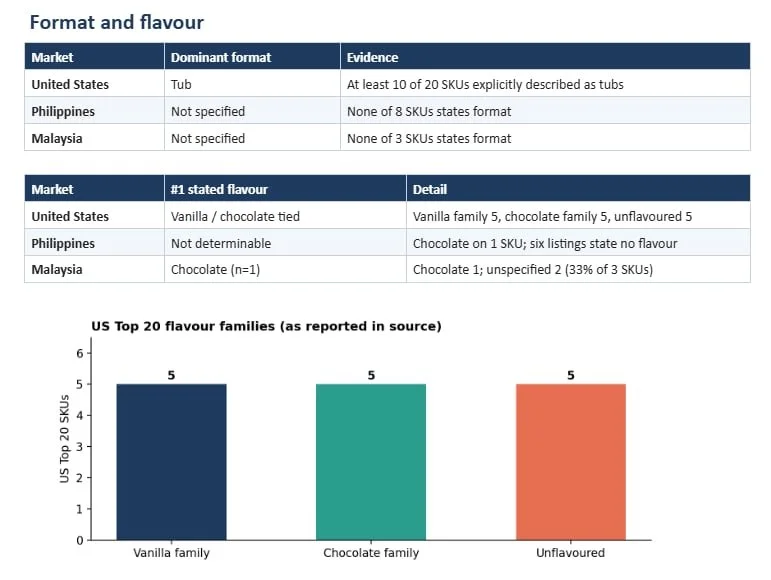
Compare at SKU level, not brand level. For every exportable SKU, record the closest verifiable equivalent in the target market’s bestseller list, and mark size, format and flavour separately as confirmed, partial or not confirmed.
Challenge the hero. Ask whether your home-market winner is a stronger priority here than your second- and third-ranked products. Require the same evidence threshold for it as for any other SKU.
Validate what the data cannot show. Where listings omit flavour, format or exact pack size, obtain it from distributor sell-through data before rating the SKU. Do not rate on assumption.
Apply the two-signal rule. Admit a SKU to the initial range only if at least two of the three variables are rated Lead or Include.
Price each SKU through the value chain. Run the Framework 08 Value Chain calculation on any SKU where size or price tier differs from market signals, before confirming it.
Sequence by confidence. Ship Lead SKUs first, pair Include SKUs with them, activate one or two Differentiation plays with a sampling or education budget, and set Hold SKUs a review point once the brand is established.
Cap the range. Aim for three to five Lead SKUs and concentrate marketing, stock and sales attention on them.
The Samana Insight framework 03 moves executives from “what products do we have?” to “which products should we prioritise here?”
Portfolio Selection is Framework 03 in the Samana Insights series, and it sits third in a sequence of progressively narrower decisions. Market Prioritisation addresses where to compete. Category Prioritisation, Framework 02 and the stated prerequisite, addresses what to compete in. Portfolio Selection then addresses which specific sizes, formats and flavours to take forward. The decisions build on one another: a right market and a right category do not guarantee that a particular SKU is right. The framework moves executives from “what products do we have?” to “which products should we prioritise here?” through five steps. Step 1 maps what the target market buys across the three variables of sizing, flavours and format, without reference to the brand. Step 2 matches each exportable SKU against those signals and rates it Lead, Include, Differentiation or Hold. Step 3 identifies gaps in the competitive set. Step 4 flags one barrier per SKU. Step 5 compiles the ranked Portfolio Shortlist. Two features improve decision quality. The comparison is relative: a SKU is judged against what the market accepts and against the rest of the range, not against its home-market record. And the output is deliberately lean, because the shortlist determines where launch resources are concentrated. Having a portfolio is a fact about the company. Knowing which products deserve to win in a particular market is a judgement about the market. The first can be read from a catalogue. The second has to be earned from evidence.The question is not which products can we sell in this market. It is which products deserve our investment here.
Explore the Portfolio Selection Framework to see how competitor signals guide SKU ratings and support evidence-based range decisions for international expansion. Explore Our Portfolio Selection Framework
