

Most market-entry plans are built around one event: the first shipment cleared, listed and live. The marketplace judges something else: whether the product is still available ten weeks later. For a US brand entering Japan, South Korea, India or Singapore, the second shipment is often the harder one.
The common assumption is that entry is the hard part and replenishment is routine. The question is not simply whether the brand can ship again. It is whether it can ship again faster than it sells out.
The gap opens for three reasons. Launch is a funded project, while the reorder falls to an operations team with no buffer. The first order is sized for caution, so a strong launch shortens the time until the next one is needed. And each restock step is known, but they are rarely added up per market before launch. The risk emerges when success arrives early.
For a US skincare brand, a sea-freight reorder takes roughly 5 to 15 weeks to reach port: 3 to 8 weeks of indicative production plus transit. Customs, regulatory checks and marketplace inbound come on top.
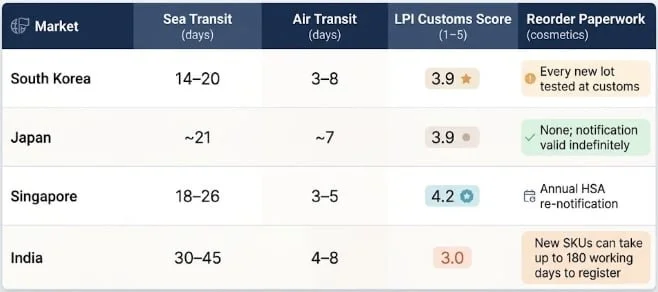
Indicative times from the US West Coast (Japan: a Dallas quote). Customs scores from the World Bank LPI 2023.
This matters because restock time is a market characteristic, like size or margin. Korea re-enters a regulatory step with every batch, even for an identical formula. India's transit is two to three times Korea's. The implication for expansion is that restock time belongs in the market-selection decision, not in the operations plan that follows it.
On a marketplace, a stock-out is a performance event the platform records and acts on.
Amazon: a seller cancellation rate above 2.5% can deactivate seller-fulfilled offers. On Amazon.in, seller cancellations have cost 8–10% of order value since 17 August 2026.
Flipkart: ₹30–₹90 per order for missed dispatches and cancellations, from 23 August 2026.
Lazada: an out-of-stock cancellation sets the product to zero inventory, taking it offline. High cancellation rates also block campaigns.
Coupang: out-of-stock products cannot be designated top items.
The ranking, reviews and campaign slots a brand paid for at launch are the first assets a stock-out erodes. Customers compound it: out-of-stocks cost retailers about 3.9% of sales globally, and online shoppers tend to switch brands rather than wait. The competitor gains a trial customer. The platform learns the brand is unreliable. The next shipment undoes neither.
The consequences arrive in sequence, each costlier than the last:
Lost sales during the gap, usually the only cost in the post-mortem.
Recovery by air, at a per-kilogram cost that can erase the market's margin.
Rank and campaign loss, so part of the launch budget is spent twice.
Lost confidence among distributors, account managers and retail buyers, which shapes the next listing or promotion slot.
The obvious fix, sending more stock the first time, swaps a stock-out problem for a capital problem. IHL Group puts 2023 global overstock losses at $562 billion, alongside $1.2 trillion from out-of-stocks. For an Entry Brand, excess stock means cash tied up in an unproven market. The more important consideration is how quickly the brand can respond. A six-week restock cycle needs far less capital at risk than a fifteen-week one.
Which market goes first. A large market with a fifteen-week restock cycle may be a poorer first market than a smaller one replenished in six. For a US cosmetics brand, India may be better sequenced after Japan or Singapore than launched alongside them.
When the reorder is placed. The reorder point is set by the restock clock, not the stock count. If restocking Korea takes 10 weeks and launch stock covers 8, the second order is late before the first unit sells. The decision is to commit the reorder, or reserve the production slot, before launch.
How capital is allocated. Options include a smaller first shipment with a pre-booked production slot, an air-freight bridge budget set before launch, buffer stock in a fast-clearing hub such as Singapore, and batch planning for Korea's per-lot testing. Each buys time with a different kind of cost.
Before the first shipment leaves, executives should be able to answer:
☐ What is our restock clock, in weeks, per market?
☐ How many weeks of sales does launch stock cover?
☐ When must the second order be committed?
☐ What does each platform do if we run out?
☐ Does a reorder trigger new testing or registration?
The principle is execution capability. A brand that can only launch has entered a market. A brand that can replenish on time has built a capability it can repeat in the next one, with less capital at risk.
If you are planning your first move into Asia, map the second shipment before you ship the first. Samana works with Entry Brands to calculate the restock clock for each target market and sequence markets around it.
Sources, all accessed 14 October 2026. Transit and production times are indicative; confirm with your forwarder and manufacturer.
