

When brands choose international markets, the instinct is often to enter the biggest market first. Size looks reassuring: it implies more customers, larger revenue potential, and stronger commercial infrastructure. But market size alone is a backward-looking measure of today’s opportunity. Growth rate is a forward-looking measure of where demand, category awareness, and competitive whitespace are heading.
This article argues that forecast growth should be a central—though not exclusive—criterion in market prioritization. Using whey protein market data across 30 countries and six regions, it shows why a smaller, faster-growing market can create more attractive medium-term value than a larger but slower-moving one.
Why the Biggest Market Is Not Always Best?
A large market can be attractive, but it often comes with four commercial challenges:
Intense competition: Established global and local brands usually defend large markets aggressively, increasing marketing, trade, and promotional costs.
Lower incremental growth: Mature markets may already have high penetration, meaning new entrants must take share rather than benefit from category expansion.
Higher entry barriers: Regulatory registration, retailer listing fees, distribution requirements, and brand-building budgets can be substantial.
Margin pressure: Price competition, private label, discount channels, and retailer bargaining power can compress gross margin.
By contrast, a faster-growing market may offer a larger share of incremental category growth. Even if the current market is smaller, a high CAGR means demand is expanding quickly, consumer education is still developing, and an early entrant can build distribution and brand equity before the market becomes crowded.
Market size answers: “How much revenue exists now?” Growth rate answers: “How quickly will that revenue expand?” For an entry decision, both matter—but growth is especially important for brands that cannot fund a long, expensive battle in mature markets.
A useful rule is to prioritize markets that combine meaningful scale with above-average growth, while treating very large but slow-growth markets as selective, partnership-led opportunities rather than immediate direct-entry priorities.
Illustrative scenario.
Consider two simplified market-entry scenarios based on the dataset:
Market A — Large but slower-growing: China has an estimated whey protein market of USD 1,030 million in 2025, but a forecast CAGR of 5.8%. It is a major opportunity, yet growth is materially below the 8% threshold used in the prioritization matrix. Market B — Smaller but faster-growing: South Korea has a smaller whey protein market of USD 275.95 million, but a forecast CAGR of 18.0%—more than three times China’s growth rate. If both markets grow for five years, South Korea’s market expands by approximately USD 249 million, while China expands by approximately USD 336 million. China still creates more absolute incremental revenue because of its much larger base. However, South Korea delivers faster percentage expansion, a more dynamic demand environment, and potentially earlier opportunities to establish premium positioning before competitive intensity rises. The conclusion is not that China should be ignored. It is that China may require a different entry model—such as e-commerce, local distribution partners, or a focused premium segment—while South Korea may justify a more direct, brand-building investment.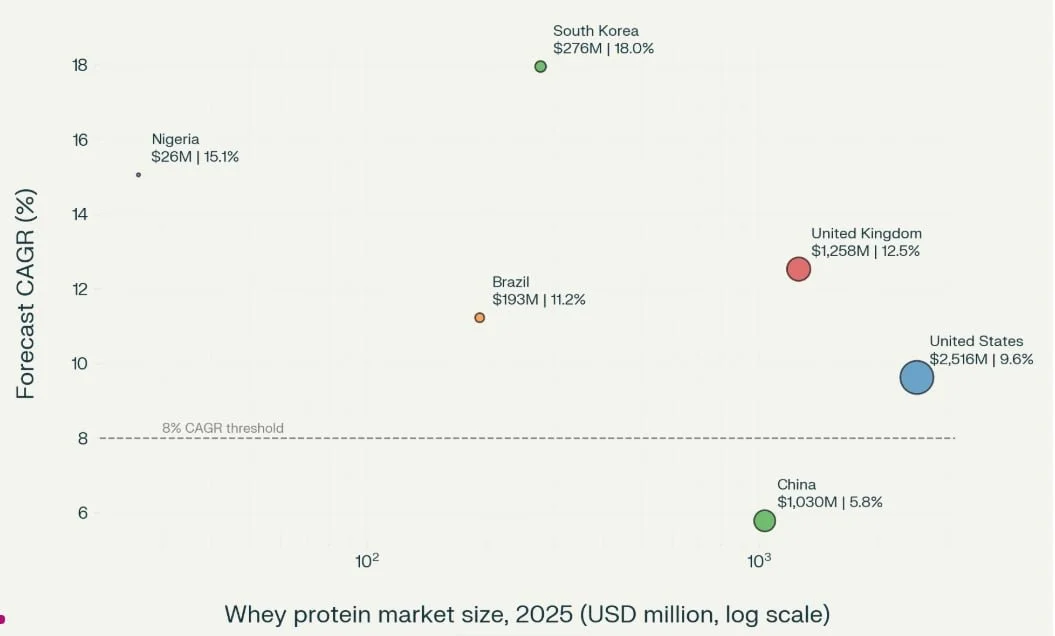
Figure 1. Market size versus forecast CAGR. Bubble size represents 2025 whey protein market size; the dashed line marks the 8% growth threshold.
The following six markets were selected to represent different regions and commercial contexts: North America, Europe, Asia Pacific, Latin America, and Africa. Together, they demonstrate how market size and forecast growth can lead to different investment priorities.
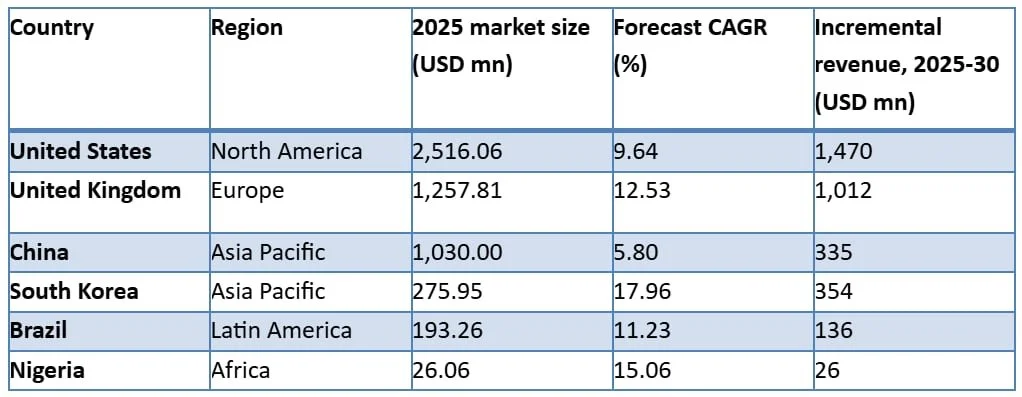
Table 1. Whey protein market size, forecast growth, and estimated five-year incremental revenue. Source: USN Global Market Size Research, whey protein segment.
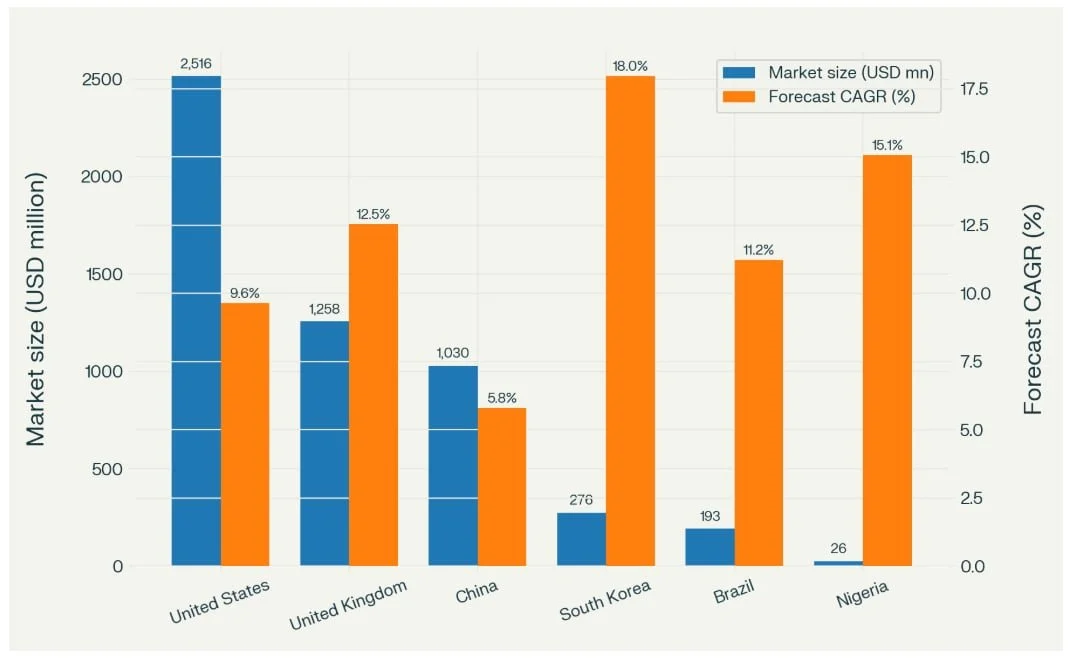
Figure 2. Market size and forecast CAGR by country. The United States and United Kingdom combine scale with strong growth; China is large but slower-growing; South Korea and Nigeria are smaller but grow fastest.
The United States is the largest market at USD 2,516.06 million, with a 9.64% CAGR. It remains a priority because it offers both scale and above-threshold growth, although entry costs and competitive saturation are high.
The United Kingdom is arguably the strongest balanced opportunity among the six: USD 1,257.81 million in market size and a 12.53% CAGR. It combines substantial scale with faster-than-average growth.
South Korea is the growth standout at 17.96%, despite a market size of USD 275.95 million. For a brand seeking early category momentum, premium positioning, or a regional Asian beachhead, it may rank above larger but slower markets.
Nigeria has the smallest market among the six at USD 26.06 million, but its 15.06% CAGR is the second highest. Its priority depends heavily on margins, payment infrastructure, import logistics, regulatory requirements, and the availability of credible distribution partners.
Brazil offers a middle path: USD 193.26 million in market size and 11.23% growth. It is below the dataset’s USD 200 million size threshold but above the 8% growth threshold, making it a credible “fast-follower” or partnership-led market.
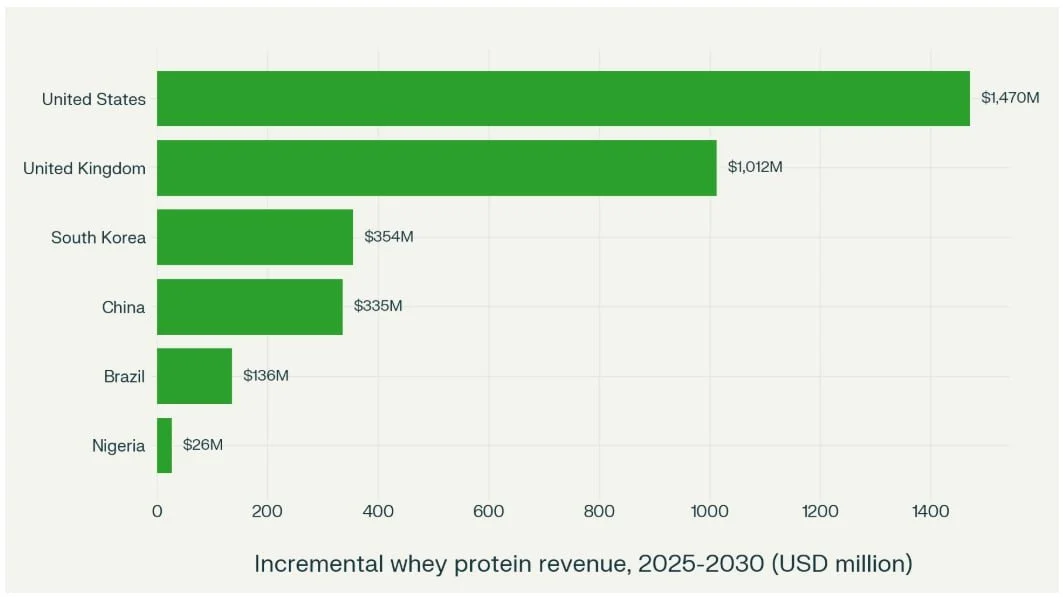
Figure 3. Estimated incremental whey protein revenue from 2025 to 2030, calculated as current market size multiplied by five-year compound growth.
Growth rate should be emphasized because it reveals momentum, but it cannot be the only filter. A market with high headline growth may still be unattractive if gross margin is too low, regulatory approval is slow, distribution is fragmented, or competitive pricing makes profitability difficult.
A practical prioritization scorecard should therefore weight growth rate heavily while also assessing:
Market size and five-year incremental revenue potential.
Forecast CAGR relative to the global or regional average.
Gross margin potential after landed cost, duties, retailer margin, and promotion.
Barriers to entry, including registration, certification, labeling, and import requirements.
Channel access, especially pharmacy, gym, specialty retail, modern trade, and e-commerce.
Competitive intensity and the cost of building brand awareness.
Currency, payment, logistics, and political risk.
Based on the six-market comparison, a practical priority sequence would be:
1. United Kingdom — large market plus 12.53% growth; strongest balance of scale and momentum.
2. United States — largest absolute opportunity and solid 9.64% growth, but requires a well-funded, differentiated entry plan.
3. South Korea — highest growth at 17.96%; attractive for premium, innovation-led, or e-commerce-first entry.
4. Brazil — above-threshold growth and meaningful regional scale; suitable for distributor-led expansion.
5. Nigeria — high growth but small base; prioritize only if margin, distribution, and regulatory feasibility are confirmed.
6. China — large but slower-growing; better suited to a selective, partner-led, or digital-first approach rather than an immediate full-scale launch.
Market prioritisation should not begin with the biggest number on a spreadsheet. It should begin with where future demand is being created. Market size tells a brand whether an opportunity is large enough to matter; growth rate tells it whether that opportunity is expanding fast enough to reward early investment.
For sports-nutrition brands, the strongest entry targets are usually those that combine adequate scale, above-average CAGR, acceptable gross margin, and manageable barriers to entry. Growth rate should be treated as a leading indicator of commercial attractiveness—not as the only decision factor, but as one of the most important.
