

Most expansion brands can tell you their revenue by market. Fewer can tell you, with confidence, how much of each sale they keep in each market and each channel. The dashboard shows list price and sales. It rarely shows what happens in between.
The question is not simply whether prices are holding. It is how much of the price survives the journey to the brand. Between the shelf price and the brand's bank account sit duty, consumption tax, channel commission, platform fees, penalties and discounts. Each differs by market. Each moves over time.
The misleading assumption is that if revenue grows and list price holds, margin holds. In practice, margin can shrink while every number on the dashboard looks stable.
The leaks start at the border and vary widely:
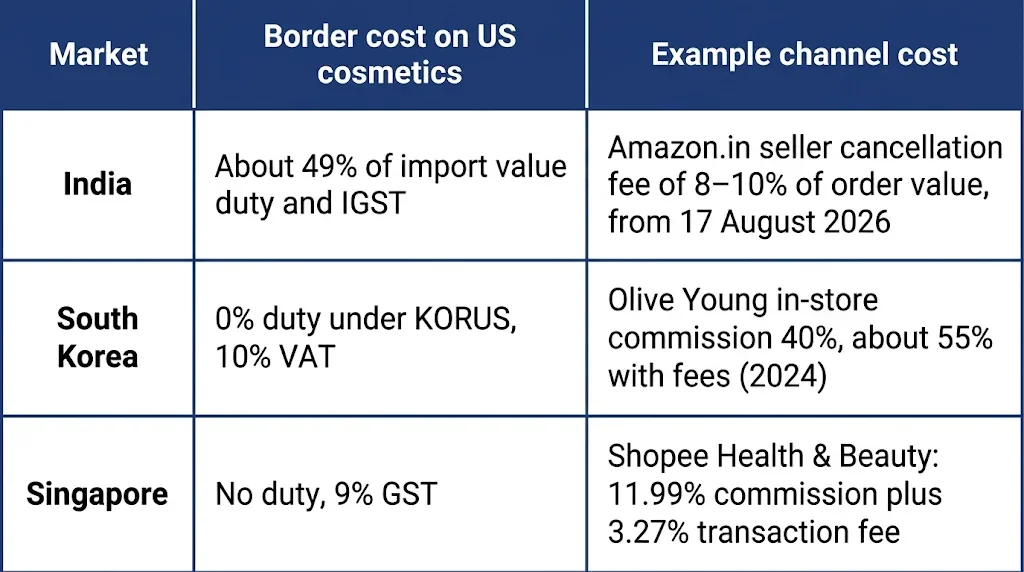
Japan adds no duty on US cosmetics, but a 10% consumption tax. Sources: EximPe, The Week, Treayo Korea, Trade.gov, Daum, IRAS, OneCart, Treayo Japan, Japan Customs.
This matters because the market with the most revenue is not necessarily the market that keeps the most per unit. A brand selling through a Korean retailer taking around 55% faces a very different waterfall from one selling through a Singapore marketplace taking about 15%. Reporting them side by side as "revenue" hides the difference.
The leaks also move. In August 2026, Amazon.in introduced a seller cancellation fee of 8–10% of order value, and Flipkart introduced penalties of ₹30 to ₹90 per order for missed dispatches and cancellations (Upstox). No pricing decision was made by the brand, yet the margin changed. Exchange rates, duty changes and new promotional programmes have the same effect.
The implication for expansion is that price is not a decision made once at launch. It is a position that erodes unless it is reviewed.
The obvious consequence is margin below what list prices suggest. The less obvious consequences matter more.
Silent drift. Fee changes, penalties and promotional costs accumulate between reviews. Without a regular check, the brand learns about them in the annual results.
The wrong winners. Investment flows to the market with the strongest revenue, which may be the one with the thinnest margin. Capital follows the wrong signal.
Off-invoice leakage. Much of the erosion sits outside the price the business monitors. In one McKinsey case, a supplier's average pocket price was about half of list, with 16.3 percentage points lost to deductions that never appeared on invoices.
An under-used lever. McKinsey found that, for an average S&P 1500 company, a 1% price increase at stable volume would lift operating profit by about 8% (McKinsey, 2003, global). The lever only works if the business can see where margin is being lost.
The risk emerges when the business assumes someone else is watching. Finance sees totals, the market team sees sales, the channel team sees fees. Nobody sees the full waterfall for each market and channel.
What executives should consider is a structured, recurring review of price against the full cost stack: a Pricing Review Analysis. Its purpose is to map, for each market and channel, what is lost at every link between list price and what the brand keeps, and to flag when that changes. [Add Samana's description of how its PRA works.]
That changes three decisions:
Where to invest. Allocate capital by margin kept per unit, not by revenue. A smaller market with a healthier waterfall may deserve more support.
What to renegotiate. A link-by-link view shows which channel terms, fees or logistics costs are worth renegotiating as volume grows.
When to reprice. Set triggers, such as a fee change, an exchange-rate move or a new duty, that prompt a review, rather than waiting for the annual budget.
Before the next budget cycle, executives should be able to answer:
☐ What do we keep per unit, after every cost, in each market and channel?
☐ Which link in each market's waterfall is the largest leak?
☐ What has changed in platform fees or penalties since we set our prices?
☐ How much margin sits in discounts and deductions we don't track as price?
☐ What would trigger a pricing review before the next budget?
The principle is commercial execution: protecting the margin that growth is meant to deliver, and making capital decisions on what each market actually keeps. This is the thinking behind Samana’s Pricing Review Analysis (PRA), which gives brands a structured way to answer the questions above. It maps the full journey from list price to what the brand keeps, for every market and channel, shows which link leaks the most, and sets the triggers that should prompt the next review.
A framework sets the method, but the numbers belong to each brand. Samana’s advisory team works with brands expanding across Asia to run the PRA on their own business: rebuilding the margin waterfall from actual channel terms, fees and discounts, identifying where margin is being lost, and prioritising what to renegotiate, reprice or restructure first. The result is a clear view of which markets are earning their place, and where the next dollar of investment should go.
If you are selling in several Asian markets and your revenue is growing faster than your profit, start with a Pricing Review Analysis to see where your margin goes, market by market.
Sources, accessed 29 October–10 November 2026 (Indian fee changes accessed 14 October 2026).
