

Most US brands enter Asia with the simplest value chain available. Product is made in the US, shipped to each market and sold. At launch, that is right: it keeps fixed costs low.
The question is not simply whether the model still works. It is whether it still fits a business that now serves four markets instead of one. As markets multiply, the distance between where product is made and where it is sold stops being a logistics detail. It becomes a cost in speed, cash and responsiveness.
The misleading assumption is that the value chain is fixed and only volume changes. In practice, the right value chain changes with scale. The risk runs both ways: staying with the launch model too long, or building regional infrastructure before volume can carry it.
Distance is easy to underestimate until it is set side by side:
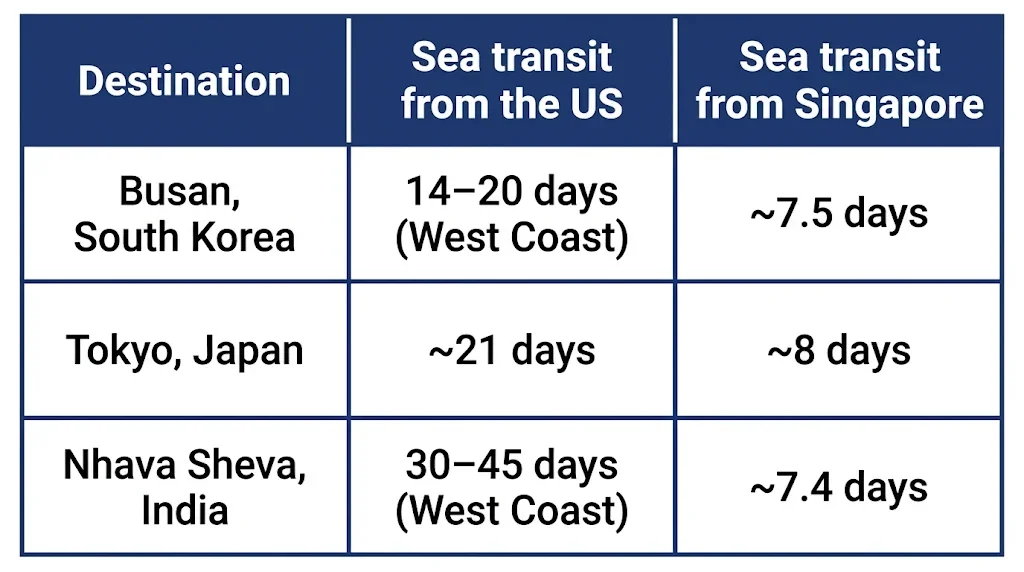
US figures are indicative port-to-port times from ExFreight Korea, Flexport and ExFreight India. Singapore figures are the fastest direct sailings listed by Fluent Cargo (Korea, Tokyo, Mumbai).
This matters because a regional hub does not remove the long leg from the US. It moves it. Stock still crosses the Pacific, but it does so once, in bulk, to a buffer within about a week of every market. Replenishment for each market then runs on the short leg, not the long one.
Singapore makes this easier on cash. In its free trade zones, duty and GST are suspended while goods are stored, and GST becomes payable only if goods enter Singapore for local sale or consumption (Singapore Customs). The Zero GST warehouse scheme offers a similar suspension for non-dutiable goods in licensed warehouses (IRAS). Stock held for Japan, Korea or India therefore does not have to pay Singapore tax on the way through.
The implication for expansion is that the hub decision is about where to hold inventory, not just where to ship from.
Consider the financials for one market. Take an illustrative US skincare brand shipping $1.2 million a year of stock (at cost) to Korea, about $3,300 a day, and holding enough stock in Korea to cover twice its resupply time:
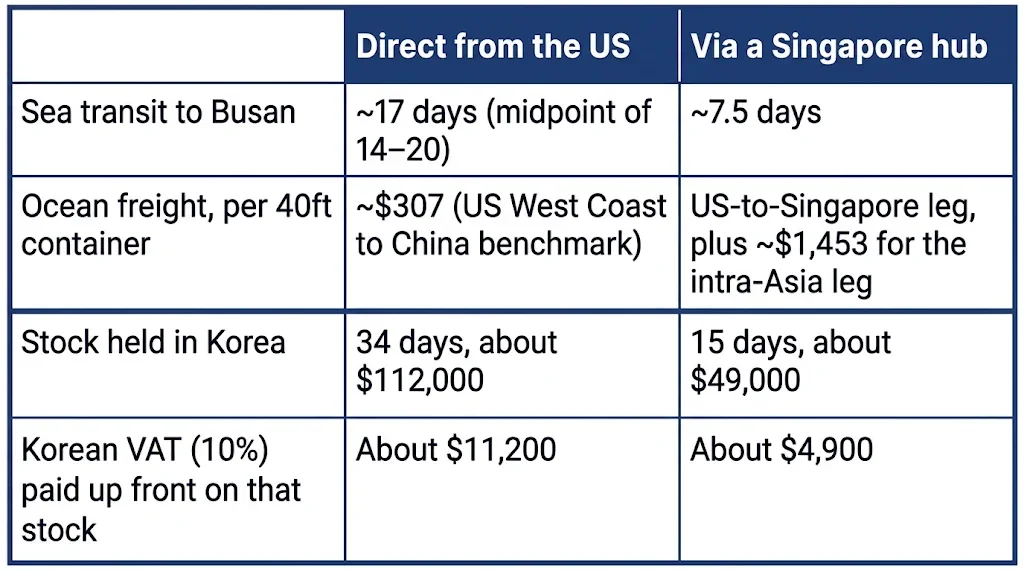
Freight figures are indicative market benchmarks, not quotes: Freightos FBX02 (US West Coast to China, as displayed 10 November 2026) and the Drewry Intra-Asia Container Index (15 October 2026). No published index was found for the US-to-Singapore leg. Brand sales and stock-holding figures are assumptions for illustration.
The result is counterintuitive. The hub raises freight, because it adds a second leg and the transpacific leg into Asia is already cheap. What it changes is cash: about $62,000 less stock sitting in Korea, with less VAT paid before the sale. That stock moves to Singapore, where tax is suspended and it can serve other markets. For one market alone, the hub rarely pays. The case builds when the same Singapore stock serves several markets and replaces emergency air freight.
The obvious costs of staying with the launch model are long replenishment cycles and expensive air freight to recover. The less obvious costs build up quietly.
Cash tied up in every market. Each market carries its own safety stock against a long supply line. Four markets mean four buffers, each sized for the slowest route.
Slower response to demand. When a campaign works in Korea, stock that is three weeks away cannot feed it. A regional buffer a week away can.
Tax paid before the sale. Stock that lands in a market pays local tax on arrival. Holding it in a tax-suspended hub defers that until the brand knows where it will sell.
A hub is not a cure-all. Each market's own rules still apply after the stock leaves Singapore: Korea's per-lot testing, India's registration and every market's labelling. Moving stock closer changes speed and cash, not compliance.
What executives should consider is the value chain as a set of stages that can move at different times. Holding stock regionally is usually the first and most reversible step. Regional labelling or packing can follow. Regional manufacturing is the largest commitment, but the capacity exists: Korea had 4,158 cosmetics manufacturers last year, and its four largest ODMs held about a quarter of the industry's 27.48 trillion won in revenue (Korea JoongAng Daily).
That changes three decisions:
Sequencing. Move the most reversible stage first. A third-party warehouse in a free trade zone tests the hub model without a fixed commitment.
Capital allocation. Compare the hub's fixed cost with the cash it releases from four separate safety stocks and from emergency air freight, not with freight savings alone.
Compliance and origin. Before moving packing or manufacturing into the region, check how it affects product registrations, labelling and trade preferences, such as Korean duty treatment under KORUS.
Before changing the value chain, executives should be able to answer:
☐ How much safety stock do we hold across all markets because of the long US supply line?
☐ How much did emergency air freight cost us last year?
☐ Which markets could be resupplied from a regional hub within a week?
☐ Which stage of the value chain is cheapest and most reversible to move first?
☐ What would moving each stage change for registrations, labels and trade preferences?
The principle is regional capability building: designing a value chain that grows with the business, one reversible step at a time. This is the thinking behind Samana Trade’s Value Chain Framework, which gives members an actionable roadmap for the decisions above. It helps them see where each stage of their value chain sits today, what that position costs in freight, cash and tax, and which stage to move next, and when.
A framework sets the direction, but the numbers belong to each brand. Samana’s advisory team works with brands expanding across Asia, such as yourself to apply it to their own business: modelling actual routes, stock levels and channel costs, testing whether a regional hub pays for itself, and sequencing each step so that capital follows volume.
If you are supplying several Asian markets and feeling the strain, start with a conversation about where your value chain should be in two years, and the first step to get there. Simply contact us at Sameer@samanaadvisory.com and we will reach out to schedule a quick 15-minute scope call.
Sources, all accessed 10 November 2026 (US transit figures accessed 14 October 2026).
